The French elite should take inspiration from Apple’s internal training program

Inside Apple’s Internal Training Program - NYTimes.com

The New York Times describes an ambitious course going from management to technology and design through the paintings of Picasso. Add some great teachers coming from the best schools and universities, innovative courses and tons of energy. It’s one thing to pretend that you want to put emphasis on company culture and innovation, it’s another to actually find the energy to do it.

If Apple goes this far… what kind of effort should employ their competitors? I remember how the French administration told me that it was impossible to allow one of their young super talented member to go to Yale for a one-year course. The French big companies from the CAC 40, the top administration, and many others should take inspiration from Apple University.

Via : Inside Apple’s Internal Training Program – NYTimes.com.

Via @sophiepene : Une “ professeur des écoles” de Denver fâchée contre Race to the Top, un programme fédéral d’évaluation des écoles

L’idée de mon interlocutrice est que les démocrates (elle vote démocrate elle-même) sont sous l’emprise d’un mouvement de destruction de l’éducation publique : l’Etat ne sait pas faire, laissons faire l’initiative privée. A la source de cette atteinte profonde elle voit de grands acteurs, au premier rang desquels la fondation Bill et Melinda Gates, qui ont donné à l’éducation une place majeure dans leur action et ont les moyens d’influencer la politique publique à l’échelle fédérale.

via @sophiepene : Une “ professeur des écoles” de Denver fâchée contre Race to the Top, un programme fédéral d… — Medium.

Is it time to call bullshit on disruption? (via Five Thirty Eight)

Corporate America Hasn’t Been Disrupted | FiveThirtyEight

Jill Lepore sparked the debate by taking up on Clayton Christensen and the disruption economy. Ben Casselman, is adding to the pressure on Five Thirty Eight – the blog of Nate Silver. Who benefits from digital innovation? Challengers and startuppers? Come on. Have you heard of Avatar?

The issue isn’t just that there are fewer startups. It’s also that fewer of them are succeeding. The advantage enjoyed by incumbents, always substantial, has been growing in recent years. The reason? Ben Casselman seems to think that it’s about an increase in state regulation. I think it’s simply because big companies have had plenty of time to adapt to not-so-disruptive technologies and economic models. Their difficulty was to find employees to address these new issues. 15 years after the startup bubble, competent people are becoming more common – especially in the US.

What’s needed now might not be less regulation, but better ones. Rules that would protect startups and innovation, and give a better headstart to new companies instead of pretending that everybody is playing in the same league.

Via: Corporate America Hasn’t Been Disrupted | FiveThirtyEight.

In the New York Times: Plot Thickens as 900 Writers Battle Amazon

Plot Thickens as 900 Writers Battle Amazon - NYTimes.com

Just as any supermarket would do, Amazon is feuding with its producers in order to get better prices. But they forgot that writers are not exactly your ordinary poultry producers – they have an ego, many fans, a vision, and thousands years of history as an industry. They don’t appreciate to be treated as producers and not as writers. And they are probably right.

Via: Plot Thickens as 900 Writers Battle Amazon – NYTimes.com.

In the New Yorker: The Power of the Amateur – how a truck driver became the best historian on the first atomic bombs

Atomic John - The New Yorker

It’s fascinating to witness the power of amateurs. They bloom where the scientists and experts let them live – outside of their bureaucratic and costly framework. In the field of archeology, it probably needed to be within some kind of techno post-modern archeology. The study of the roman empire is too crowded by distinguished researchers. But the study of the atomic bombs that exploded 70 years ago is a fresh field for anyone to enter. Especially for truck drivers. What a breeze.

Via: Atomic John – The New Yorker.

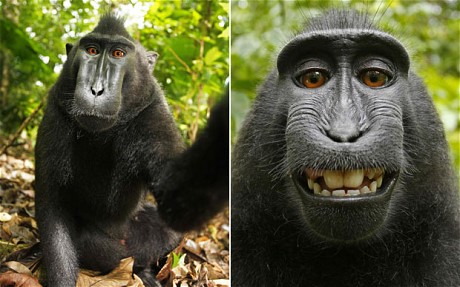
Wikipedia refusing to erase the Monkey Selfie is politically dangerous

The copyright case of the monkey selfie

In a case of ridiculous and typically geekish legal battle, Wikipedia refuses to remove a photograph that a monkey took of itself by pushing the button of the camera of David Slater, a photographer. 

People were quick to pretend that Slater has no right to the copyright to the photo.

The Gloucestershire-based photographer now claims that the decision is jeopardising his income as anyone can take the image and publish it for free, without having to pay him a royalty. He complained to Wikimedia that he owned the copyright of the image, but a recent transparency report from the group, which details all the removal requests it has received, reveals that editors decided that the monkey itself actually owned the copyright because it was the one that pressed the shutter button.

They came back from the idea that the Monkey owned the copyright to the photo – some Wikipedia users still think he could own it, but Wikipedia still pretends that the photographer has no right on it. They even pretend that it should belong the Public Domain.

The case seems pretty clear though. The creation was made without the photographer, but thanks to a bit of luck, and to a scheme that he organized, the Monkey pushed the button and took a beautiful picture. It looks a lot like an automatic creation – the vocabulary might be different under US jurisdiction – and copyright should thus be given to the photographer as the indirect creator of the picture. Just like when you setup a camera somewhere and allow it to take automatic pictures.

If it was only another stupid copyright case, there should be no harm. But I see dangerous trends here:

  • Wikipedia is putting the Public Domain at risk by overextending it to illegitimate things… it’s one thing to fight against the extension of Copyright terms, it’s another to try to get free access to the work of actual artists… They used to be more cautious on these issues.
  • Just like in the « right to be forgotten issue », Wikipedia chose a maximalist and libertarian interpretation to decide what norms should apply online, creating a dangerous conflict with our existing liberties and freedom… and showing little or no respect for the works and wills of those who don’t belong to the « community »

This is bad omen at a time when people have more and more questions about the bad sides of the digital world on our society. Companies like Google, Uber and AirBNB are under pressure everywhere. But the Wikimedia Foundation is a not-for-profit and a role model for many other projects. They should probably stay out of these political and commercial issues. It’s a worrying sight to see them on this road.

Via Kottke: The copyright case of the monkey selfie.

Can we still call « startups » multinational companies that adopt the worse lobbying practices from their predecessors?

« What Airbnb doesn’t explain is why it is staging protests against the friendly legislation it has been secretly co-authoring since at least January, 2013—or why the company’s demands have changed. According to emails obtained by the San Francisco Bay Guardian, an Airbnb lobbyist pushed San Francisco Supervisor David Chiu’s legislative aides to change the legislation, allowing hosts to rent their homes for up to 120 days per-year. But now Fair to Share’s « members » are lobbying for an 180 day allowance.

In a statement to the Examiner, Airbnb spokesperson Nick Papas said « the company is proud of its part in the campaign » and home sharing is « making The City a better place to live. » »

Via Valleywag : Airbnb is Astroturfing Against Legislation They Helped Write.

Airbnb is Astroturfing Against Legislation They Helped Write

« The Right to be forgotten » means that information should be free as in freedom

Apparently, Jimbo thinks that it’s « insane » to allow citizens to control the information about them when it’s used by a private company. There is a growing division here between people who think that information should be « free as in freedom », and people who think that information should be « free as in available at no cost for giants who have the means to use it ».

In Valleywag and The Observer: Europe’s « Right to be Forgotten » Law Kills Its First Wikipedia Page.

Europe's

In Wired : The Abandoned Facebook Tech That Now Helps Power Apple

People, Sciences, Companies… I love the history of tech…

Out in the Open: The Abandoned Facebook Tech That Now Helps Power Apple | Enterprise | WIRED.

Out in the Open: The Abandoned Facebook Tech That Now Helps Power Apple | Enterprise | WIRED

Dans Le Figaro : Google dénonce des emails pédopornographiques à la police

« Un homme de 41 ans a été arrêté par la police de Houston dans l’État du Texas, pour détention de pédopornographie. L’homme, déjà condamné pour agression sur mineur en 1994, aurait envoyé un email contenant des photos pédopornographiques en passant par Gmail. Les autorités locales ont expliqué avoir été alertées par Google, qui scanne automatiquement tous les emails qui passent pas son service. »

Si c’est vrai, ça va encore faire des histoires…

Google dénonce des emails pédopornographiques à la police.

Google dénonce des emails pédopornographiques à la police